
Jesus Holding a Lamb Painting
Jesus holding a lamb painting
“Jesus Holding a Lamb Painting” is a gentle image many of us quietly keep in our homes. It is not just decoration. It can become a small reminder of being known, carried, and loved, especially on ordinary days when faith feels simple and fragile.
On this page I would like to share how a Jesus holding a lamb painting can fit naturally into a Catholic home, prayer corner, or office space, without pressure or big promises—just the quiet company of Christ in daily life.

Why this image speaks so quietly to the heart
For many Catholics, the image of Jesus holding a lamb is deeply familiar, yet it never really grows old. It reflects the tenderness of the Good Shepherd, who knows each one of us personally and carries us when we are weak. It is peaceful, gentle, and reassuring, especially in seasons when life feels confusing or heavy.
I remember the first time I brought a Jesus holding a lamb painting into my home. It was a difficult year, and I was not looking for something dramatic—just a small way to keep my eyes on Christ in the middle of normal, busy days. I hung it in a simple frame in the hallway, and I found myself stopping there almost without thinking, even for a brief moment, to breathe and say, “Lord, I’m here.”
This is how sacred art usually works in a Catholic home. It does not draw attention to itself. Instead, it quietly points beyond itself. A painting like this can become part of the background of daily life—there when we pass with our coffee in the morning, when we come home tired, or when we tuck children into bed at night.
Placing a Jesus holding a lamb painting in your home
Different homes will use this image in different ways. Some families place it in a main living area, where everyone passes often. Others prefer a more private corner. There is no single “right” place; it depends on your space and on how you pray.
Here are a few gentle ideas:
- Near the front door: As a quiet reminder when you leave and when you come home.
- Beside a favorite chair: Where you like to read, pray, or simply unwind in the evening.
- In a small prayer corner: With a crucifix, a candle, and perhaps a rosary on a little table or shelf.
- In a child’s room: As a gentle way to remember that Jesus loves and cares for them.
- Near your desk: If you work from home and want a subtle reminder of God’s presence during your day.
Over time, the painting can become part of small routines: a quick sign of the cross before leaving for work, a brief “thank You” at the end of the day, or a whispered prayer when you feel tired or anxious.

Connecting the painting with the Good Shepherd
The image of Jesus tenderly holding a lamb is rooted in Scripture and in the long tradition of Christian art. Many Catholics naturally connect it with Jesus as the Good Shepherd, especially from the Gospel of John.
Sometimes it helps to remember that this is not just a sweet picture. It points to something real: Christ who knows His sheep, calls them by name, and never forgets them. If you like, you might read or pray with the passage about the Good Shepherd from time to time while looking at the painting. For some, this becomes a simple way to stay grounded when life feels noisy.
If you ever want to explore the background of this kind of image, the article on Good Shepherd symbolism offers some helpful historical context about how Christians have pictured Christ this way through the centuries.
But you do not need to study art history to appreciate a Jesus holding a lamb painting. What matters most is the quiet way it helps you remember that you are not alone, even when you feel small or unsure.
Personal experiences with a Jesus holding a lamb painting
Over the years, I have had different versions of a Jesus holding a lamb painting in my home. One was a small canvas near a bookshelf, another was a framed print in the hallway. They were not fancy, but each one came into my life during a time when I needed a reminder that God’s care is steady, even when my emotions are not.
There was a season when I would pass the painting late at night after a long day, stop for just a moment, and say very simply, “Lord, carry the people I love.” I did not always have the energy for long prayers. The image itself helped me trust that He knew what I could not put into words.
Another time, a child in the family asked, “Why is Jesus holding the lamb like that?” It opened a gentle conversation about how God does not forget anyone, especially those who feel lost or weak. The painting became a kind of starting point for talking about faith in an honest, age-appropriate way, without pressure.
For me, a Jesus holding a lamb painting has never been about decorating a room. It has been a way of keeping my eyes, even briefly, on the One who quietly holds us, especially when we do not feel strong.

How a Jesus holding a lamb painting can support simple daily prayer
A painting does not replace prayer, Mass, or the sacraments. But it can gently support them by giving our hearts something quiet to rest on. In a world full of screens and noise, a still image of Christ can be like a calm pause in the middle of the day.
Here are a few very simple ways Catholics sometimes pray with this kind of image:
- Morning pause: Stand or sit near the painting for a few seconds, and offer your day to the Lord in your own words.
- Brief intercession: When someone you love is struggling, you might look at Jesus holding the lamb and quietly say, “Lord, carry them.”
- End-of-day gratitude: Before bed, spend a moment there and name one or two small blessings from the day.
- During anxiety: When worries are loud, you might focus on the calm face of Christ in the painting and repeat a simple prayer like, “Jesus, I trust in You,” at your own pace.
- With children: Invite them to say goodnight to Jesus in the picture with a short, sincere prayer.
No special formula is needed. Your own honest words, or even wordless trust, are enough. The painting is simply there to help you remember that you are seen and cared for, even on ordinary days that feel unremarkable.

Choosing a style that fits your home and prayer life
When people look for a Jesus holding a lamb painting, they often discover that there are many different artistic styles. Some are very realistic, others are more soft and impressionistic, and some use modern colors or abstract backgrounds. It can help to think about what truly settles your heart instead of what feels impressive.
Here are a few aspects to consider as you look at different versions:
1. Color and mood
Some paintings use warm, gentle colors—soft golds, browns, and creams—that create a quiet, comforting mood. Others use cooler tones, like blues and greens, which can feel peaceful and contemplative. Think about the light in the room where you will place it and how the colors will feel there during the day and at night.
2. Expression of Jesus
The way the artist paints the face of Christ makes a big difference. Some show Him looking directly at you, others show Him looking at the lamb. You might notice which expression helps you feel most at peace or most drawn to pray. There is no rule here—only what helps you remember His presence.
3. Size and placement
Smaller prints work well on a bookshelf, nightstand, or in a small prayer corner. Larger canvases can become a main piece on a wall. If you live in a small apartment, a modest-sized Jesus holding a lamb painting might feel more natural and less overwhelming.

4. Material and finish
Some people prefer a framed print behind glass, others like a stretched canvas without a frame. A canvas often feels softer and less reflective in bright light, while a framed print can look more traditional. Neither is more “holy” than the other; it is simply about what feels right in your space.
Using a Jesus holding a lamb painting with other devotional items
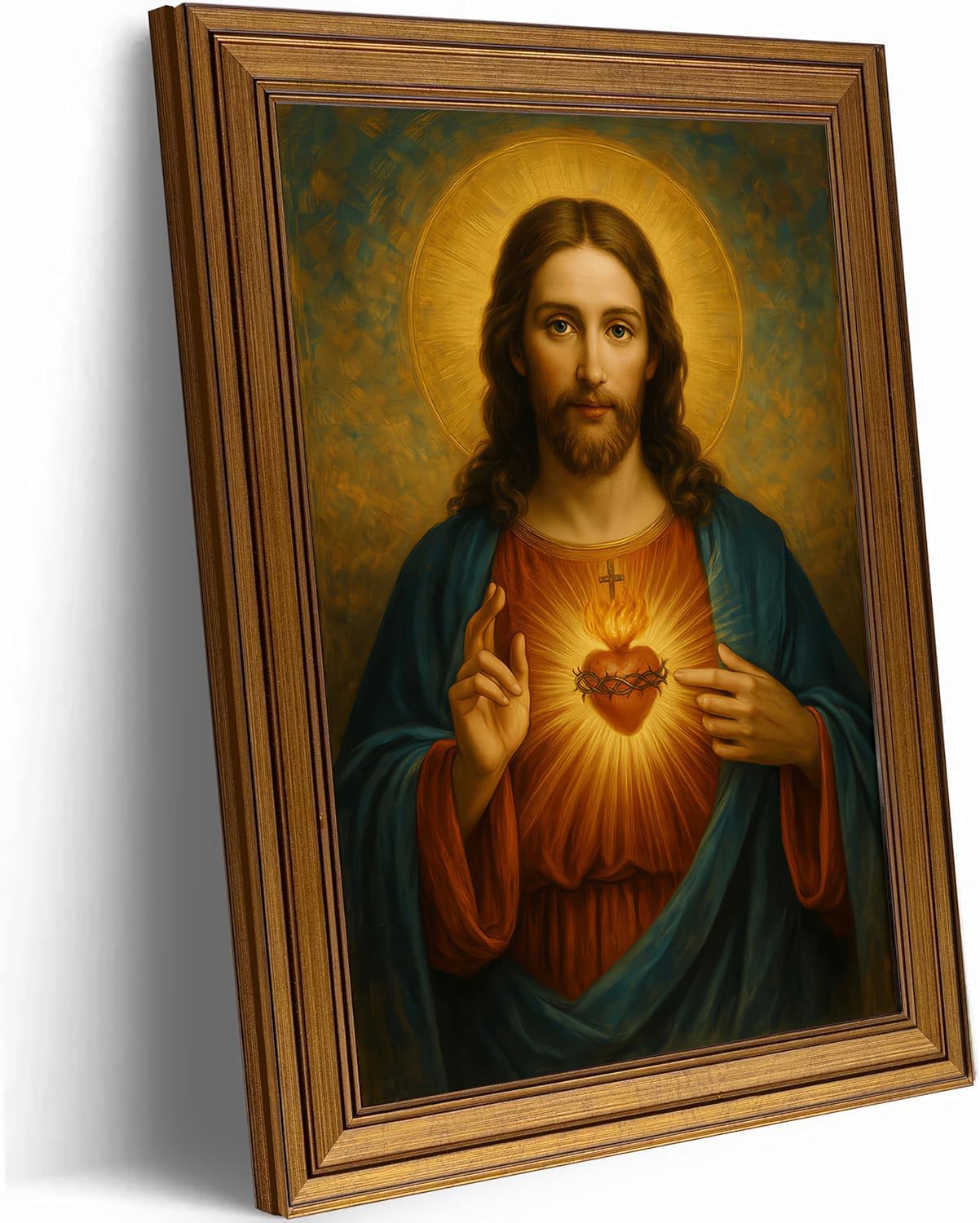
Many Catholic homes have a small collection of devotional items: a crucifix, a rosary, a statue of Mary, a candle, perhaps a Bible open on a table. A Jesus holding a lamb painting can sit gently among these, without competing for attention.
Some simple combinations might be:
- A crucifix on the wall, and below it, a painting of Jesus holding the lamb, with a small candle on a shelf.
- A family Bible on a side table, with the painting hanging above, creating a small corner for shared or private prayer.
- A statue of the Blessed Mother next to a framed print of Jesus holding the lamb, reminding us that Mary always leads us to her Son.
What matters is not how many items you have, but whether they truly help you turn your heart to God in the middle of daily life. If your space is small or cluttered, even one simple painting can be enough.
Respectful care for sacred images
In Catholic life, we treat sacred images with respect because of Who they represent. This does not mean we must be anxious or scrupulous about them, but it does invite a certain gentle care.
If you decide to have a Jesus holding a lamb painting in your home, you might consider:
- Placing it somewhere that is generally clean and orderly, as a sign of reverence.
- Avoiding locations where it will be easily damaged or disrespected, even unintentionally.
- From time to time, dusting the frame or canvas as a small act of care.
If, many years from now, the painting becomes too worn or you need to part with it, Catholics traditionally avoid simply throwing holy images into the trash. Some choose to burn or respectfully bury worn images, or to ask a parish if they have guidance. This is not about rules as much as it is about gratitude for how the image helped you pray.
Jesus holding a lamb painting as a gentle gift
A Jesus holding a lamb painting can sometimes be a meaningful gift, especially in quiet or painful seasons: after a loss, during illness, or in times of stress. It can say, without many words, “You are not forgotten. You are held.”
If you ever choose to give this kind of painting, it might help to keep it simple. There is no need for long explanations. A short note such as, “I thought this might bring you some peace,” can be enough. Let God work quietly in the recipient’s heart, without expectations.
I once gave a small Jesus holding a lamb painting to a friend who was going through a long, uncertain medical situation. Months later, they told me that during some sleepless nights, they would look at the painting and whisper short prayers, even when they felt too tired to say much. The image did not solve their problems, but it gave them a peaceful place to rest their thoughts for a moment.

Frequently asked questions about a Jesus holding a lamb painting
1. Is it okay for Catholics to have a Jesus holding a lamb painting at home?
Yes. Catholics have used sacred images in their homes for centuries as gentle reminders of God’s presence and love. A Jesus holding a lamb painting is one of many traditional ways to remember Christ as the Good Shepherd. The image itself is not an object of worship, but it points us toward the Lord and can help us focus when we pray.
2. Where should I place the painting for prayer?
You can place it wherever you naturally spend quiet moments: near a chair where you like to read, in a small prayer corner, in a bedroom, or near the front door. Many people find it helpful to choose a spot where they will see the painting several times a day, so that it becomes part of daily rhythms—morning, evening, and in-between.
3. Do I need to have the painting blessed?
You do not have to, but many Catholics like to ask a priest or deacon to bless religious images. If you decide to do this, you can simply bring the Jesus holding a lamb painting (or a photo of it, if it is large) to your parish and ask if someone is available to offer a short blessing. Whether blessed or not, the value of the image is in how it helps you turn your heart to God.
4. How can I involve my children with this image?
Children often respond strongly to pictures. You might invite them to look at the painting and ask, “What do you see? How does the lamb look? How do you think Jesus feels about the lamb?” This can gently lead to talking about how the Lord cares for them. A short family prayer in front of the painting—even just one or two simple sentences—can become a small, steady ritual.
5. What if I do not feel anything when I look at the painting?
That is completely okay. Faith is not measured by emotion, and prayer does not always feel strong or moving. A Jesus holding a lamb painting is simply a gentle help, not a test. You can still use it as a quiet focal point while you talk to God in your own words, or even when you sit silently. Over time, the familiarity of the image can become comforting, even if you do not notice anything dramatic.