
Jesus the Good Shepherd painting
Jesus The Good Shepherd Painting
A gentle image of Christ as the Good Shepherd can quietly shape the atmosphere of a home. It does not need to be dramatic or flashy; often, a simple painting is enough to remind the heart that we are held, known, and cared for.
Among the many sacred images Catholics treasure, a Jesus the Good Shepherd painting has a special kind of tenderness. It shows the Lord not distant or severe, but close, carrying the lost sheep, guiding the flock, and walking through hills and fields that feel almost familiar. For many of us, this image has accompanied quiet moments of prayer more than we realize.
In my own home, the first time I hung a Jesus the Good Shepherd painting was during a stressful season. I remember standing in front of it late one evening, in the half-dark of the living room, and letting the picture say what I did not have words for: “You see me. You see my family. Please guide us.” Nothing spectacular happened, but the room felt less lonely, and my worries felt a little less heavy. Since then, the Good Shepherd has been an image I return to again and again.
A painting like this does not need to turn the house into a chapel. It just quietly marks the space as a place where faith is welcome. Children notice it. Guests notice it. Even on rushed mornings, when prayer is short and distracted, the Good Shepherd on the wall has a way of catching the eye and steadying the heart for a moment.

Why the Good Shepherd image feels so familiar
The idea of Jesus as the Good Shepherd runs deep in Christian memory. Many of us heard it first in childhood Bible stories or during homilies about being cared for and not forgotten. A painting takes that familiar theme and gives it a steady place in our daily surroundings.
When the Good Shepherd is on the wall, we do not have to try hard to remember that image; it is simply there, day after day, like a quiet companion. For parents, it can be reassuring to know that children grow up with this gentle picture of Jesus in their field of vision. For those who live alone, it can soften the silence of the house and remind them that they are not as alone as they sometimes feel.
Art historians often point out how the shepherd theme appears even in the earliest Christian art in the catacombs. It has always spoken to believers who wanted to remember Christ as someone who carries, searches, and stays close. A modern Jesus the Good Shepherd painting continues that tradition in a way that fits naturally into today’s homes.
Placing a Jesus the Good Shepherd painting in the home
Choosing where to place a sacred image can feel like a small decision, but it shapes how often we actually pray with it. Some Catholics like to hang a Good Shepherd painting in the living room, where family life happens: homework, conversations, celebrations, and disagreements. Others prefer the bedroom, where the day begins and ends. There is no single “right” spot; what matters is that it is somewhere you naturally look.
In my house, the Jesus the Good Shepherd painting started in the hallway, almost as an afterthought. Over time, I realized I passed it dozens of times a day, especially when I was hurrying from one room to another. Eventually, I moved it to a wall where I could pause more easily. Now, a quick glance at the Good Shepherd has become a kind of small, wordless prayer between tasks.
Many families like to include this kind of painting in a simple home prayer corner, alongside a crucifix, a rosary hanging on a nail, or a small statue. It does not have to be elaborate. Even a small table with a candle and a Good Shepherd image can become a place where the family gathers for night prayers or where someone sits quietly with a psalm after a long day.
Different visual styles of Good Shepherd art
Not every Jesus the Good Shepherd painting looks the same. Some are very realistic, with detailed landscapes and carefully painted sheep. Others are more symbolic, with softer lines and warmer colors that feel almost like an icon. Some show Jesus holding a lamb on his shoulders; others picture him standing in the midst of the flock, staff in hand.
It can help to think about what kind of image draws you into prayer. Do peaceful, muted tones calm your heart? Or do you prefer bright, vivid colors that lift your mind? Are you drawn to a more traditional look, or something slightly more modern but still reverent? There is room in the Church for many artistic expressions, as long as they honor the Lord with dignity and respect.
Over the years, I have noticed that my own heart responds more readily to paintings where Jesus’ face is gentle rather than stern. A soft gaze, a hint of a smile, or the way he cradles the lamb often speaks to me more than any particular color or background. You might find that some images of the Good Shepherd immediately feel like “home” to you, while others leave you unmoved. It is perfectly fine to be honest about that and to choose what truly helps you pray.



For those who appreciate the broader Christian story of sacred art, it can be interesting to remember how long the image of Christ as shepherd has been cherished. Even in early Christian times in Rome, the figure of the shepherd carrying the sheep was used to speak of Christ’s care for souls, a theme also familiar from the description of the Good Shepherd in the Gospel of John, as discussed in the article on the Good Shepherd.
Using a Jesus the Good Shepherd painting in daily prayer
A painting, by itself, is just paper or canvas and ink. It becomes part of prayer only when we approach it with intention. That does not mean complicated devotions or special formulas. Often it is as simple as pausing in front of the image and quietly telling the Lord what is on our hearts.
One very simple practice is to stop by the Jesus the Good Shepherd painting at the start or end of the day. Some Catholics like to stand there for a brief moment, make the sign of the cross, and entrust the day or the night to Christ’s care: family worries, work concerns, health struggles, and all the ordinary burdens that build up. The painting becomes a familiar “meeting place” with the Lord, even when words are few.
During seasons of anxiety, I have sometimes found myself just sitting near our Good Shepherd painting with a rosary in my hands, not even praying all the mysteries, just holding the beads and looking at the image. The combination of the familiar prayer and the steady figure of Jesus with the lamb has helped me breathe more slowly and remember that I am not in control of everything—and that I do not have to be.
Families with children might find that a Jesus the Good Shepherd painting opens gentle conversations. A child may ask, “Why is Jesus holding that sheep?” or “Why does he have a staff?” Those small questions are opportunities to talk very simply about how God cares for us, without heavy explanations or debates, just in the language of trust and love that children naturally understand.
Personal stories with the Good Shepherd
Catholics often have quiet, personal memories linked to certain images of Christ. For me, the Jesus the Good Shepherd painting is especially connected with a challenging year when a family member was very ill. We had the painting near the entrance of the house, and every time I came back from the hospital, I would see it as I opened the door.
I remember one night in particular: it was late, and the house was dark. I turned on the hallway light and saw the Good Shepherd’s face. I did not say anything out loud, but I stood there for a minute and simply looked. The thought that came to me was, “You care about this person more than I do. You see them completely.” That moment did not remove the pain or the uncertainty, but it anchored me. The painting had become more than decoration; it was a steady reminder of a truth I needed to remember.
Over time, using a Jesus the Good Shepherd painting like this can build up its own quiet history in a household. It becomes associated with morning prayer before work, with bedtime prayers with little ones, with evenings when we bring our worries to God. Visitors may never know those stories, but the family does, and that gives the image a special place in the heart.
Many people also like to give a Good Shepherd image as a gentle gift for baptisms, First Communions, confirmations, or even housewarmings. It is not a loud statement. It is a simple way of saying, “May you always remember that you are cared for.” The painting then begins writing a new story in another home, quietly accompanying that family’s particular joys and struggles.
Practical details: size, framing, and care
When choosing a Jesus the Good Shepherd painting for home use, practical questions matter too. A very large piece can be striking, but sometimes a more modest size fits better into everyday spaces like hallways, bedrooms, or small prayer corners. Thinking ahead about where you want to hang it can help you choose a size that feels natural instead of overwhelming.
Framing can also change how the image feels. A simple, dark wooden frame can give the painting a traditional, grounded look. A lighter or white frame can blend more easily with modern decor while still keeping the focus on Christ. Some Catholics prefer a frame with a bit of ornament, while others favor clean lines. There is freedom to choose what best reflects the atmosphere you hope to nurture at home.
Taking care of the painting is mostly a matter of common sense: keeping it away from direct sunlight to prevent fading, dusting the frame gently, and making sure it is hung securely. Treating it with care is one small way of honoring the Lord whom the image represents. It reminds us that faith is not something we only bring to church; it belongs in the way we live and care for the spaces around us.

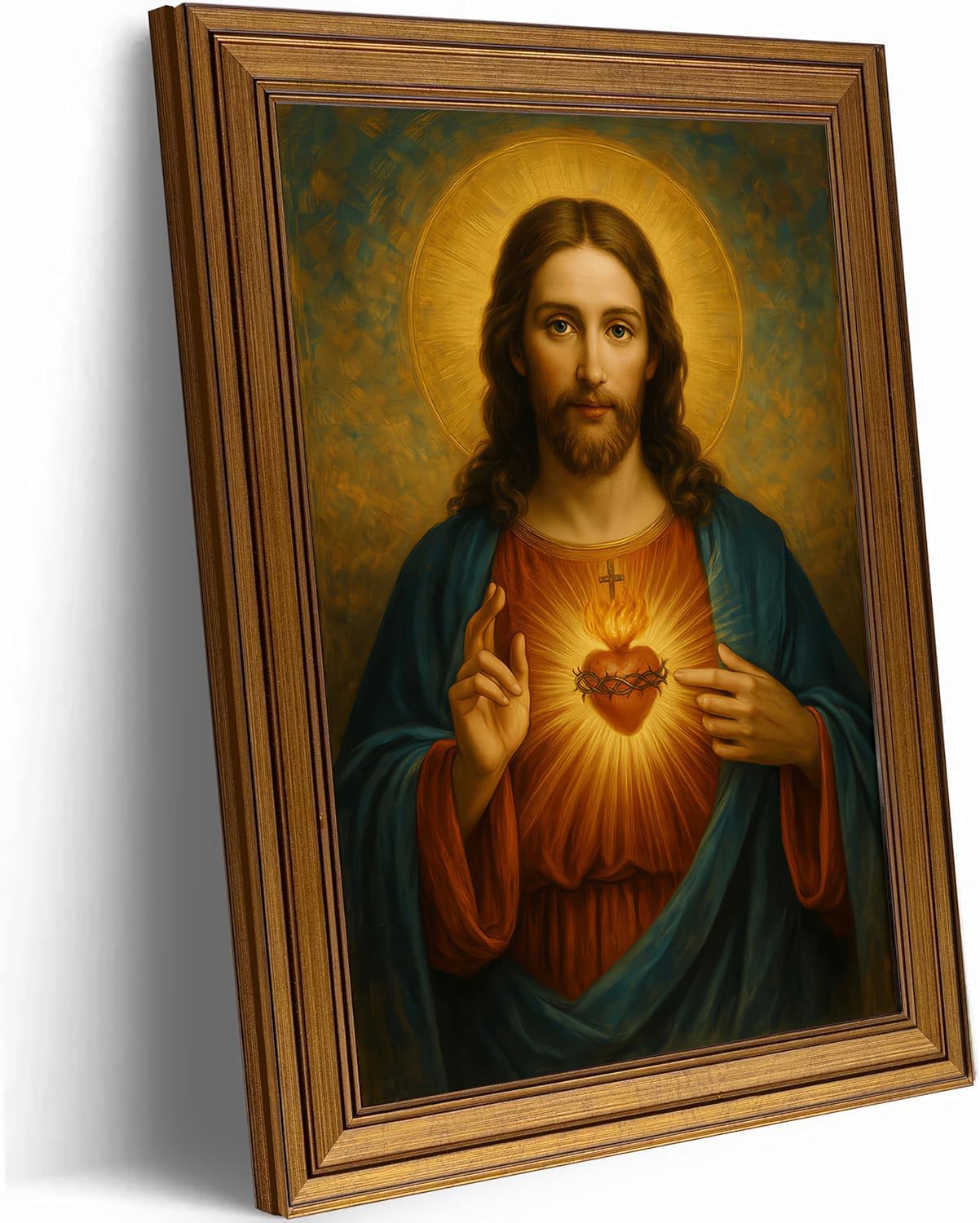

Even these down-to-earth details—choosing a frame, deciding on a size, finding the right wall—can be done in a spirit of quiet prayer. We can simply ask the Lord to bless our home, to make it a place where his presence is remembered, and to use even a simple Jesus the Good Shepherd painting to keep our hearts turned gently toward him in the middle of ordinary life.
Questions about Jesus the Good Shepherd paintings
1. How can I pray with a Jesus the Good Shepherd painting if I am not used to using images?
You do not need any special method. You can simply stand or sit quietly in front of the painting and speak to Jesus in your own words, as you would speak to a trusted friend. You might tell him what is worrying you, thank him for specific blessings, or ask for guidance. Some Catholics like to read a short passage from Scripture about the Good Shepherd and then sit in silence, letting the image and the words stay together in their hearts. The point is not to force a feeling but to be honest and present before God.
2. Is it okay to have a Jesus the Good Shepherd painting in my bedroom?
Yes. Many Catholics place sacred images in their bedrooms as a way of beginning and ending the day with the Lord. A Jesus the Good Shepherd painting in the bedroom can be a gentle reminder to entrust your sleep, your dreams, and your concerns to Christ’s care. It can also be helpful for couples or individuals who like to say night prayers before turning off the lights. The bedroom is often one of the quietest places in the home, which makes it a natural spot for a prayerful image.
3. What makes a Jesus the Good Shepherd painting “suitable” for Catholic use?
For Catholic use, an image should show Jesus in a way that is respectful, modest, and faithful to Christian understanding. That usually means avoiding anything mocking, irreverent, or distorted. A suitable Jesus the Good Shepherd painting will depict the Lord with dignity and love, often holding or guiding the sheep. Beyond that, there is room for different artistic styles. Many Catholics simply ask themselves, “Does this help me think of Christ with reverence and trust?” If the answer is yes, it is likely a helpful image for prayer.
4. How can I involve my children in choosing a Good Shepherd image?
Children often respond strongly to images, sometimes even more than adults. You might show them a few different Jesus the Good Shepherd paintings and ask which one makes them feel peaceful or safe. Let them tell you what they notice—the lamb on his shoulders, the staff, the expression on Jesus’ face. When they feel included in the choice, they are more likely to take the image to heart and to pray in front of it. You can also invite them to draw their own version of the Good Shepherd and place it nearby as a sign that Jesus cares about their creativity and their prayers too.
5. Can a painting like this help when I am struggling with faith?
A painting cannot fix doubts or make faith easy, and it should not be treated like a magic object. But many Catholics find that during times of inner struggle, having a steady, gentle image of Christ nearby can make it easier to stay in conversation with God. When prayer feels dry or confusing, you can simply sit before the Jesus the Good Shepherd painting and say, “Lord, I am not sure what I believe right now, but I know I want to stay with You.” The image can serve as a visual reminder that God’s patience is greater than our confusion and that we are still being gently watched over, even when our feelings are unsettled.
If you feel drawn to welcome this image of Christ into your home, it can be a quiet companion on ordinary days and in difficult seasons alike, reminding you that you are never outside the care of the Good Shepherd.
See more options