
Middle Eastern Jesus Painting
Middle Eastern Jesus Painting
Bringing a Middle Eastern Jesus painting into the home feels, for many of us, like gently opening a window toward the land where the Gospel first took shape. It is not just a decorative choice. It can be a quiet way of remembering that the Lord truly walked this earth in a specific place, among real people, with dust on His feet and sun on His face. For Catholics in America, surrounded by so many images and styles, choosing an image that reflects the Lord’s Middle Eastern roots can be a simple act of honesty, reverence, and closeness to the biblical story.
Over the years I have lived with different images of Christ on my walls. Some were very Western, some more symbolic, and some tried to capture His Semitic features more faithfully. One of the most meaningful seasons for me was when I first placed a Middle Eastern Jesus painting near our front door. I noticed visitors pause for a second look. More importantly, I noticed how often I found my own eyes drawn to it before leaving for work or coming back home, almost like a quiet reminder: “He is real. He is near.”
A piece like this can gently shape the atmosphere of a room. It does not need to be large or dramatic. Even a modest-sized painting, thoughtfully placed, can become a natural point where family members pause, whisper a short prayer, or simply take a breath before moving on with their day. The goal is not to impress anyone, but to live with an image of Christ that is truthful, dignified, and rooted in the tradition handed down across centuries.

Why a Middle Eastern Jesus Painting Matters in Daily Life
In many American homes, religious art has become almost invisible because we are so used to it. A small sacred image may hang in a hallway or above a door, but our eyes pass over it quickly. When we choose a Middle Eastern Jesus painting, we are also choosing to remember that Christ did not belong to any modern nation or culture. He lived in the ancient Middle East, among people whose features, clothing, and landscapes were very different from what most of us see every day.
This kind of image can nudge us out of habit. It can remind us that the Gospel does not start in our own time and place, but in a specific history. For me, this has sometimes changed the way I read the Sunday readings. Seeing a more historically grounded face of Jesus on the wall, I imagine the dusty roads of Galilee, the crowded streets of Jerusalem, the fishermen with calloused hands. The painting helps bridge the gap between the world of Scripture and the world of my living room.
I remember one evening, after a hard day, I sat on the couch and just looked at the painting for a while. There was nothing dramatic about it. The colors were warm, the expression was calm. I did not hear any “message,” but I did feel something settle inside. It was like being reminded that Christ knows what it is to live in a real body, in a complicated world, in a land of both beauty and tension. That quiet realization made my own worries feel more shareable in prayer.
A Middle Eastern Jesus painting can also gently challenge the images we grew up with. Many of us knew only light-skinned, European-looking portraits of Christ as children. They were created with sincere devotion, and they still have a place. But adding an image that leans closer to His Semitic heritage can deepen our understanding without rejecting anything. It broadens our sense of the Church’s universality, showing that Christ truly came for all peoples, yet was also deeply rooted in one people and one land.
Placing the Painting: Corners of Quiet Prayer
Where we place a sacred image matters more than we might think. A Middle Eastern Jesus painting can become the heart of a small prayer corner, or it can simply be the central piece above a couch or dining table. What counts most is that it sits in a spot where eyes naturally rest and where the family moves often during the day. You do not need a large home or a special room; even a small apartment can hold a quiet corner for the Lord.
In my own home, one of the first places I tried was the space near the dining table. We gathered there every day, and the painting slowly became part of our mealtime rhythm. Sometimes we would say grace and simply glance at the image together before eating. It was a small thing, but over time it gave our meals a more peaceful tone. It reminded us that every ordinary moment, even washing dishes and sharing leftovers, can be lived under the gentle gaze of Christ.
Another time, I moved the painting to a little corner by the bookshelf, where a small chair and a lamp already stood. That corner was where I liked to read and pray quietly at night. Placing the painting there gave me a focal point for those simple, tired prayers at the end of the day. I would sit, look at the face of Jesus, and let the worries of the day surface in silence. There was no magic in it. It was just honest, human prayer, helped by an image that felt close to the Jesus I meet in the Gospels.
You might find that placing the painting near the front door works well. Leaving for work in the morning, or returning home in the evening, you can pause for a second: “Lord, thank you for this day,” or “Walk with me,” or “Stay with us tonight.” Short, simple phrases. No elaborate devotions required. The painting simply becomes a reminder that the Lord’s presence reaches into commutes, errands, and late-night returns.


Seeing His Face: Color, Expression, and Detail
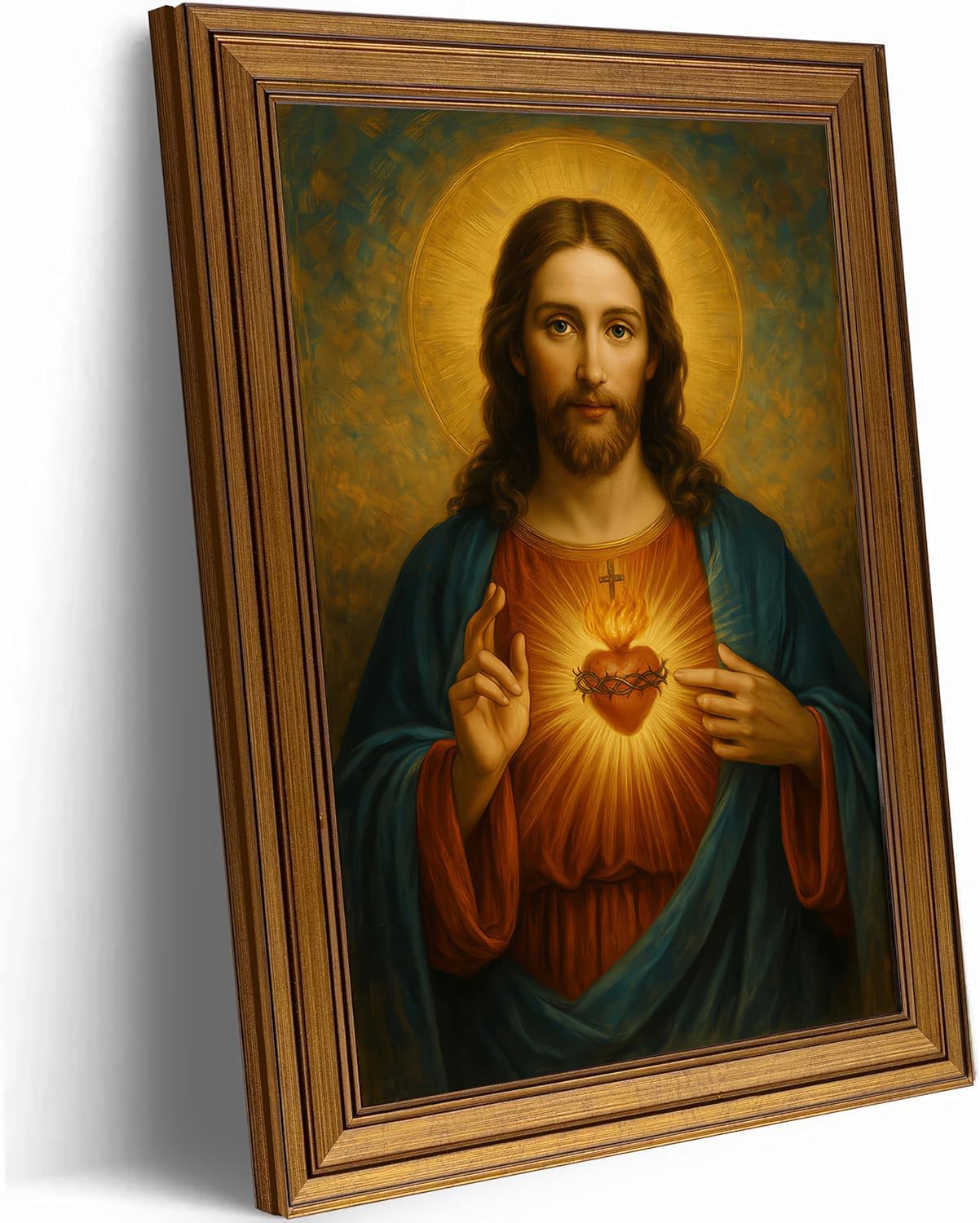
When we stand before a Middle Eastern Jesus painting, certain small details can quietly help our prayer. The tone of the skin, the shape of the eyes, the texture of the hair, the background landscape or city scene—all of these can either draw us into the biblical world or distract us from it. Many modern artists who focus on a more historically grounded Jesus choose earth tones, simple robes, and backgrounds that suggest stone streets, rugged hills, or desert light.
I have noticed that I am drawn to images where the Lord’s expression is neither sentimental nor harsh. A gentle seriousness, sometimes with the slightest hint of a half-smile, seems to invite honest conversation. It feels more like someone I can sit across from and speak to as I am. One Middle Eastern Jesus painting I lived with for a while had eyes that seemed almost tired yet deeply kind. On difficult days, that detail made me feel less alone: the sense that Christ understands weariness from the inside, not only in theory.
Color also matters. Warm, muted tones can create a sense of peace and familiarity. Deep blues and browns can echo the night sky, the sea, or an old wooden door in an ancient town. When the background hints at a Middle Eastern landscape—a distant city wall, an olive tree, or stone steps—the whole scene feels anchored in a real place. That, in turn, can anchor our prayer in reality rather than in vague ideas.
None of this means we must become art critics. You do not need technical knowledge to know whether a painting helps you pray. The central question is simple: when you look at this face, do you feel invited to speak to the Lord? If the answer is yes, then the style is probably doing its quiet work. A more historically rooted Middle Eastern Jesus painting can support that sense of closeness by reminding us that the Lord fully entered a concrete culture, time, and body.

Family Life, Guests, and Gentle Conversations
A Middle Eastern Jesus painting can quietly shape the way faith appears in a household, especially around children and visitors. Kids may ask simple questions: “Why does Jesus look like that?” “Where did He live?” Those questions open small opportunities to talk about Scripture, geography, and the real people of the Bible. We do not need perfect answers. Even saying, “Jesus lived in a Middle Eastern land called Israel, and people there often looked more like this than in older paintings,” can be enough to plant a true image in their hearts.
I remember one conversation with a friend who was not Catholic but noticed our Middle Eastern Jesus painting in the hallway. They paused and said, “I’ve never seen Jesus pictured like that before.” We ended up talking, not about arguments or doctrines, but about how we both picture God, and how much it matters to remember that Jesus was an actual man from a real place. That small conversation stayed with me for a long time. The painting did not pressure anyone; it simply invited curiosity.
For extended family members who may have grown up with very Western images of Christ, a Middle Eastern style can feel unfamiliar at first. Some might even wonder why it looks different. These moments can be handled gently, with respect for the images they knew as children. You might say something like, “I grew up with fair-skinned portraits too, and I still appreciate them. This one just helps me remember that Jesus really came from the Middle East. It makes the Gospels feel closer to real history for me.”
In a way, the painting becomes a quiet guest in the home, present at birthdays, holidays, and ordinary Tuesdays alike. It stands there during arguments and reconciliations, during nights of worry and mornings of peace. Over time, the image may gather memories: the Christmas when everyone was sick, the Lent when someone returned to confession after many years, the Sunday afternoons when the house was finally quiet. None of these moments belong to the painting itself, of course, but the image is there, watching with us, reminding us Whose presence truly holds the home together.
Caring for the Painting Over the Years
Sacred images are not just objects to be rotated with trends. Many Catholics prefer to keep a good painting for years, even decades, letting it age with them. A Middle Eastern Jesus painting can become part of the family’s story in this way. Taking simple care—keeping it clean, out of direct harsh sunlight when possible, and securely hung—can help ensure that it remains a steady presence.
In my own experience, dusting the frame or gently wiping the glass has almost become a small act of devotion. It is a quiet way of saying, “This matters to me.” Sometimes, while straightening a crooked frame, I find myself offering a short prayer without planning to. Even such everyday gestures can be a form of reverence, not because the object is magical, but because of Whom it represents.
Over the years, our tastes may change. We might move to another home or rearrange furniture. When that happens, it can be good to pause before moving a Middle Eastern Jesus painting. Ask yourself where in the new layout you most want to be reminded of Christ’s presence. Maybe it is near a window where morning light falls on His face, or at the top of a staircase where you pass by many times each day. These little decisions can shape the rhythm of prayer more than we realize.
Sometimes, an older painting may start to show signs of age: fading colors, a slightly worn frame. In many families, these marks simply become part of the story. They remind us that faith has walked with us through time. If the wear becomes distracting, a new frame or a refreshed print can restore clarity. What matters most is that the image continues to help you look toward the Lord with simplicity and trust.
Simple Ways to Integrate the Painting
A Middle Eastern Jesus painting does not require elaborate devotions. It can fit naturally into an ordinary Catholic routine:
- Glancing at the image while making the Sign of the Cross in the morning.
- Pausing for a brief moment of gratitude before meals.
- Adding a candle nearby only on Sundays or special feasts, if desired.
- Letting children place a small flower or drawing near the image occasionally.
- Spending a few minutes in silence there after returning from Mass.
None of these are rules. They are simply gentle ways to respond to the presence of Christ in the home, expressed through a face that looks closer to how He likely appeared in His own land.

Frequently Asked Questions About Middle Eastern Jesus Paintings
Yes. The Church has long encouraged sacred art that helps believers contemplate Christ’s life and presence. A Middle Eastern Jesus painting can be very fitting because it reflects more accurately the land and people among whom He lived. As long as the image is respectful and modest, it can be a meaningful addition to a Catholic home, just like traditional European-style images. The important thing is that it leads you toward prayer, not away from it.
There is no special method you must follow. You can simply sit or stand before the painting, look at the Lord’s face, and speak to Him in your own words. Some people like to read a short Gospel passage and then gaze at the image in silence, imagining that they are meeting the same Jesus who walked in the Middle East. Others just glance at it briefly when they pass by, whispering a simple phrase like, “Jesus, be with me,” or “Thank You, Lord.” The painting is there to support your natural, honest prayer.
The “best” place is wherever you and your family naturally spend time and can easily see it. Common choices include near the dining table, in the living room, by the front door, at the top of the stairs, or in a small prayer corner. Some people keep a Middle Eastern Jesus painting in their bedroom for quiet evening prayer. It can help to avoid spots where the image might be bumped, splashed, or treated carelessly, simply out of respect for what it represents.
This is a common situation, and it can be handled gently. You do not have to choose one style and reject the other. Many Catholic homes blend different images: a Middle Eastern Jesus painting in one room, and more familiar Western-style sacred art elsewhere. You can explain that this new image helps you remember where Jesus actually lived, while still respecting the older images that nourished the faith of your parents or grandparents. The goal is not to argue about art, but to grow together in a deeper sense of who Christ is and where He came from.
When you look at the painting, notice how you respond inside. Do you feel invited to turn your thoughts toward the Lord? Does the expression on His face draw you into honest, simple prayer? Does the style respect Jesus’ dignity and human reality? If so, that may be a good sign that the image is right for you and your home. There is no obligation to like every painting you see. It is perfectly fine to be patient until you find one that peacefully resonates with your own walk of faith.